

Skip to content

High-fidelity API traffic simulation from your IDE.

Gopher-Glide (gg) is an open-source, high-fidelity API traffic simulator. Move beyond brute-force load testing with native IDE integration, zero-config profiles, and an interactive TUI that lets you inject chaos in real-time.

The Hive Engine 🐝

A modern architecture for massive scale. Unlike older tools relying on heavy OS threads, the new Hive Engine uses a pure-Go lock-free Actor Model.

By isolating connections into ultra-lightweight Goroutines, a single instance can easily generate over 50,000 RPS with zero-garbage (0 allocs/op) overhead.

graph TD
    Queen[πŸ‘‘ The Queen] -->|Micro-batches| Hatchery[πŸ₯š The Hatchery]
    Hatchery --> Actor1[🐝 Actor Goroutine]
    Hatchery --> Actor2[🐝 Actor Goroutine]
    Actor1 -. API Request .-> API
    Actor2 -. API Request .-> API

βš”οΈ Resource Benchmark: At 10,000 RPS, gg consumes 4.2x less RAM and 26% less CPU time than Grafana k6, while suffering 3x fewer OS context switches. Read the full benchmark breakdown to see how gg safely simulates massive traffic inside resource-constrained CI/CD pipelines.

Whether you are running on a high-end developer workstation, a standard laptop, or a virtualized cloud runner, the engine scales linearly to extract maximum value from your hardware. Check out the full Performance Benchmarks to see the cross-platform scaling data.

Zero Scripting Required

Reuse your existing .http REST Client files directly. If you want to run a quick load test, there is no need to rewrite your API calls in JavaScript or Python. Just point gg at your existing IDE scratch files and go.

### Simulated User Journey
POST http://api.example.com/login
Content-Type: application/json

{ "user": "tester", "pass": "secure" }

> {%
    client.global.set(
        "token", response.body.token
    );
%}

### Fetch user profile using token
GET http://api.example.com/profile
Authorization: Bearer {{token}}

Zero-Config Profiles

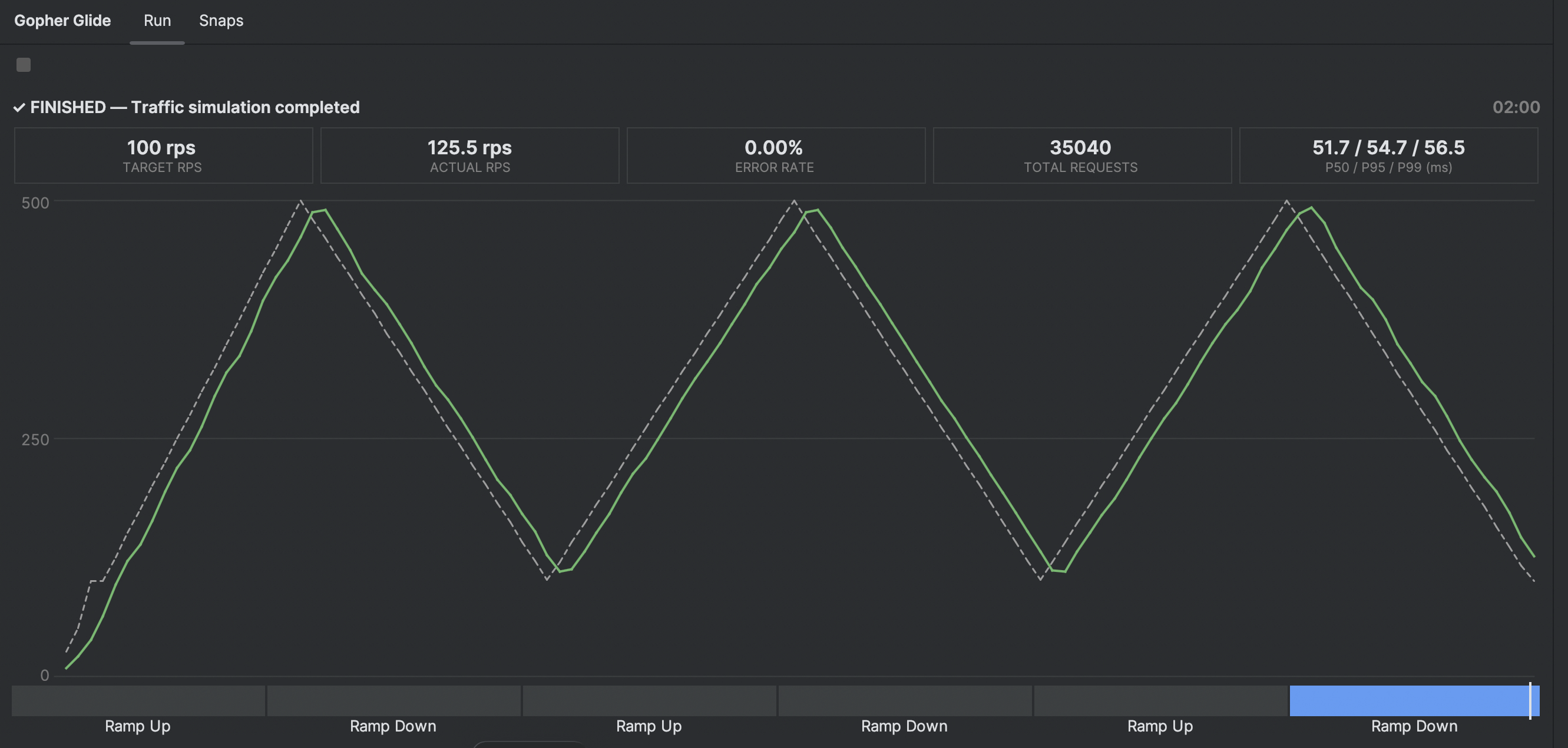
Skip writing complex YAML configs. Use built-in patterns like --profile flash-sale or --profile ddos to generate standard industry traffic shapes instantly.

Perfect for quick validation or CI/CD pipelines where you don't want to maintain external configuration files.

$ gg --hive-engine \
    --http-file checkout.http \
    --profile flash-sale

[Stages]
1. Ramp Up: 0 -> 1000 RPS (30s)
2. Sustain: 1000 RPS (2m)
3. Cool Down: 1000 -> 0 RPS (30s)

[Status] Running Stage 2 (Sustain)...

Interactive Chaos TUI

Adjust traffic in real-time using the newly polished, premium interactive TUI. Targeting a smooth ~24 FPS, you can bias RPS up or down using your arrow keys, and watch the terminal UI react instantly without stutter or lagβ€”styled beautifully by default with a Catppuccin Macchiato palette.

Combined with the --snap flag, you can record behavioral snapshots of your API's latency, status distributions, and inferred JSON schemas.

Interactive Chaos TUI Demo

Semantic Diffing πŸ”¬

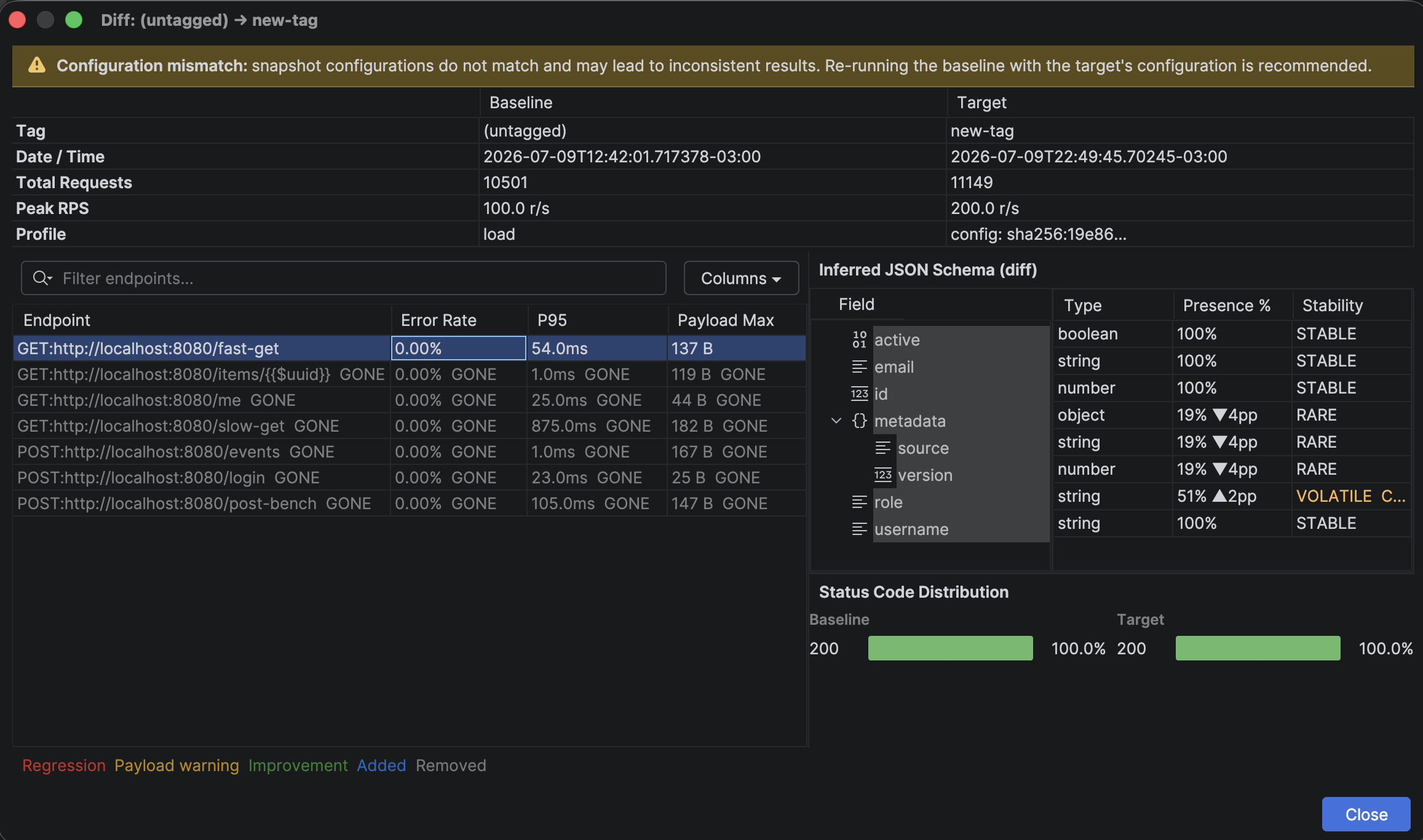
Know why your API broke, not just when. Traditional tools tell you P99 latency spiked. gg snap diff tells you it spiked because a developer accidentally injected a 2MB blob into the JSON payload.

By continuously sampling traffic, Gopher-Glide infers your API's schema in real-time. Compare two snapshots side-by-side to instantly spot missing fields, type changes, or massive payload bloat.

GET:http://localhost:8080/fast-get  [❌ REGRESSION]

Latency Deltas      Payload Deltas      Error & Status
 P50:    +100.0%     Avg:    +100.0%     Error: -100.00 pp
 P95:    +100.0%     P95:    +100.0%
 P99:   +5200.0%     Max:    +100.0%     200:   +100.0 pp
 Max:    +785.7%

Schema Changes
 + active          added  boolean  100% STABLE
 + email           added  string   100% STABLE
 + metadata        added  object    18% RARE
 + metadata.source added  string    18% RARE

Automated CI/CD Gates 🚦

Don't let regressions reach production. Gopher-Glide is built for more than just local chaos testing. Drop it directly into your CI/CD pipelines to enforce hard limits on performance and payload shapes.

Use gg snap assert to automatically break the build if a Pull Request spikes P99 latency by 10% or removes a critical field from your JSON schema.

jobs:
  api-regression:
    runs-on: ubuntu-latest
    container: shyam-s00/gopher-glide:latest
    steps:
      - name: Run API Simulator
        run: |
          gg --hive-engine \
            --http-file api.http \
            --snap --snap-tag ${{ github.sha }} \
            --headless

      - name: Enforce API Contracts
        run: |
          gg snap assert \
            --baseline main \
            --current ${{ github.sha }} \
            --latency-regression 10 \
            --deny-removed-fields

Why Gopher-Glide?

If you want to run a quick concurrency test, you usually have to write a custom script or learn a heavy configuration language. gg lets you skip the boilerplate.

Feature Gopher-Glide (gg) k6 / Locust wrk / hey / vegeta
Scripting None (Reads .http natively) JavaScript / Python None (CLI flags only)
Traffic Control 30-FPS Interactive TUI (Arrow keys) Requires configs Fixed concurrency only
CI/CD Assertions Semantic JSON Diffing (gg snap) Pass/Fail Thresholds Raw latencies only
Built-in Profiles Yes (--profile flash-sale) Requires scripting No
IDE Integration Native JetBrains Plugin External scripts External tools
Performance 30k+ RPS per core (Actor Model) Medium-High Extremely High

Get started in minutes

No scripting language to learn, no config files to maintain β€” reuse what's already in your IDE.

01

Install

Get the binary via Homebrew, or grab a prebuilt release for Linux/Windows.

brew install shyam-s00/tap/gg
02

Write a Journey

Reuse your existing .http files. Chain requests into a stateful Journey by exporting a value with @gg-export and referencing it as {{token}} in the next request.

### Login
# @gg-export token = jsonpath: $.data.token
POST http://api.example.com/login
Content-Type: application/json

{ "user": "tester", "pass": "secure" }

### Fetch profile
GET http://api.example.com/profile
Authorization: Bearer {{token}}
03

Pick a Profile

Skip the YAML β€” choose a built-in traffic shape that matches your scenario.

gg --hive-engine \
  --http-file checkout.http \
  --profile flash-sale
04

Simulate & Watch

Drop into the interactive TUI, bias load up or down with the arrow keys, and capture --snap snapshots as you go.

[Stages]
1. Ramp Up: 0 -> 1000 RPS (30s)
2. Sustain: 1000 RPS (2m)
3. Cool Down: 1000 -> 0 RPS (30s)

[Status] Running Stage 2 (Sustain)...

Frequently Asked Questions

Everything you need to know about Gopher-Glide.

What is an API traffic simulator?

Unlike traditional API load testing tools that blindly spam endpoints, a traffic simulator like Gopher-Glide creates stateful, multi-step user journeys. It mimics human think-time and realistic behaviors, giving you high-fidelity insights into how your backend actually performs under real-world pressure.

Is Gopher-Glide a k6 or JMeter alternative?

Yes. If you are looking for a modern, open-source alternative to k6, JMeter, or Locust, Gopher-Glide offers a zero-code approach. Instead of writing complex JavaScript or Python scripts, you reuse your existing .http REST Client files directly from your IDE.

How much load can a single instance generate?

Thanks to the new pure-Go lock-free Hive Engine, a single Gopher-Glide instance can comfortably push over 50,000 RPS (Requests Per Second) on modern hardware without exhausting system memory or triggering garbage collection pauses.

Can I run this in my CI/CD pipeline?

Absolutely. You can use our official Docker image (docker pull shyam-s00/gopher-glide) to easily drop it into any CI/CD workflow like GitHub Actions or GitLab CI. By passing the --headless flag, Gopher-Glide outputs structured data instead of the UI. You can even use gg snap assert to create automated regression gates that break the build if API latency spikes.

Stop testing load. Start simulating reality.

Open-source, highly concurrent, and built in Go.

Star us on GitHub ⭐